
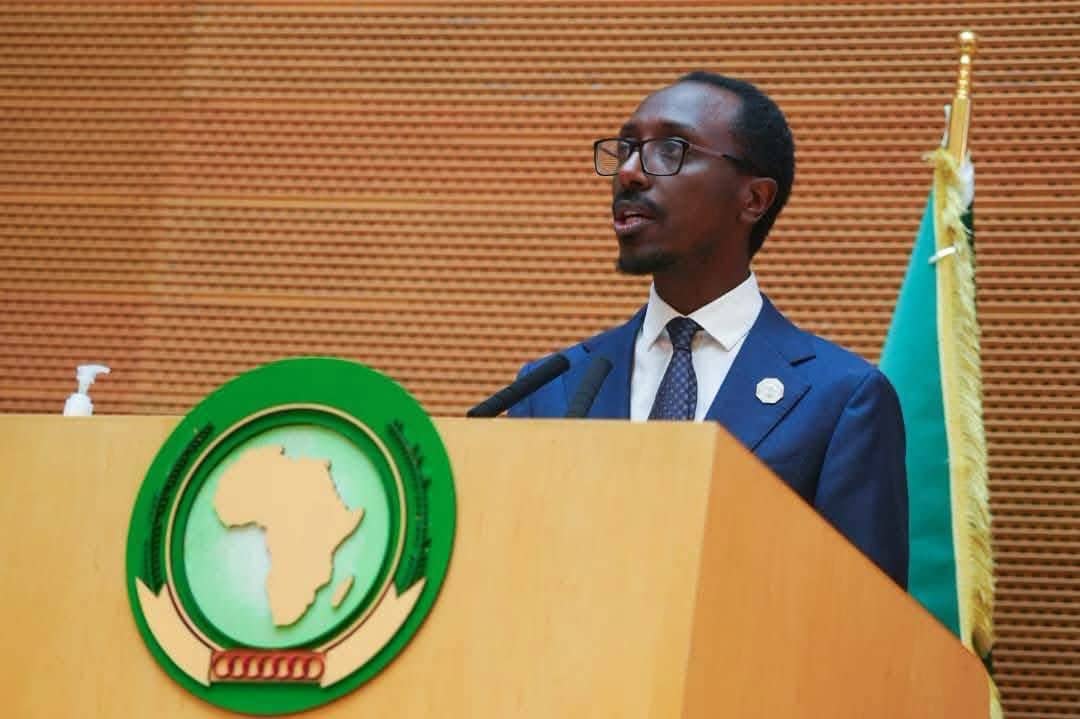
Beneath the language of solidarity and institutional reform, Foreign Minister Gedion Timothewos’ address to the African Union Executive Council carried a broader strategic message: Ethiopia appears increasingly interested in complementing its role as host of Africa’s premier institution with a more active contribution to its strategic direction.
Some speeches summarize a moment. Others signal a broader direction. Foreign Minister Gedion Timothewos’ remarks at the 49th Ordinary Session of the African Union Executive Council in Addis Ababa appear to belong to the latter category. At the surface, the address was an appeal for African agency in an increasingly turbulent international environment. Geopolitical rivalry is intensifying, climate pressures are mounting, and technological change is reshaping economic and political power. Africa, Dr. Gedion argued, must become an active participant in the emerging order rather than a passive observer of it.
The more revealing element, however, was the strategic framing beneath that appeal. Read closely, the speech points to an Ethiopia seeking to complement its role as institutional host with a more active contribution to the African Union’s agenda.
Africa’s Defining Moment
Addressing foreign ministers and delegates at AU headquarters, Dr. Gedion described the present period as a defining moment for the continent. The assumptions that shaped the post-Cold War order are being challenged by shifting alliances, competition over strategic resources, and growing demands for reform across the multilateral system. His central message was clear: Africa’s future should be shaped by Africans. To advance that objective, the Foreign Minister identified three priorities: accelerating AU reform, securing the Union’s financial sustainability, and strengthening African ownership of the continent’s strategic resources. He presented these not merely as administrative tasks, but as foundations of continental influence and autonomy. He also pointed to Africa’s economic trajectory, noting that several of the world’s fastest-growing economies are on the continent. The broader implication was that institutional reform can no longer remain an aspiration. It is becoming a strategic necessity.
Beyond Institutional Stewardship
For decades, Ethiopia’s relationship with the African Union has largely been understood through the lens of stewardship. Addis Ababa hosts the institution, provides much of its diplomatic infrastructure, and occupies a distinctive place in Africa’s political imagination. That role remains important. Yet hosting an institution and shaping its priorities are different forms of influence. Dr. Gedion’s remarks suggest that Ethiopian diplomacy increasingly recognizes this distinction. By framing AU financing and reform as questions of strategic autonomy rather than solely technical matters, the address positions Ethiopia as a supporter of a stronger and more independent Union.
This extends beyond institutional maintenance. It contributes to shaping the terms of the continental debate. A more financially autonomous AU would have greater room to define continental priorities with less dependence on external actors. Stronger institutions could also improve Africa’s collective leverage in negotiations on trade, climate, peace and security, and emerging technologies. For Ethiopia, this agenda also aligns with important national interests. A stronger African Union headquartered in Addis Ababa would reinforce the city’s standing as Africa’s diplomatic capital while supporting Ethiopia’s relevance in continental affairs. Realizing this opportunity, however, will depend on Ethiopia’s ability to complement its geographic and historical position with sustained diplomatic engagement, policy contributions, and coalition-building.
The Politics of Resource Governance
One of the most consequential elements of the speech was its emphasis on the “strategic ownership and responsible management of Africa’s resources.”
The phrase is broad in scope. It can encompass not only minerals and energy, but also shared waterways, regional infrastructure, economic corridors, and the governance arrangements that increasingly shape relations among African states. By presenting resource governance as a continental concern, the speech contributes to the institutional language through which these questions may be debated. States can shape international politics not only through material capabilities, but also through their ability to frame issues and advance widely accepted principles. By emphasizing cooperation, equitable utilization, and African-led solutions, the address advances a vocabulary that may resonate beyond Ethiopia’s immediate national priorities. This approach places Ethiopian priorities within wider continental objectives. Rather than emphasizing narrowly defined claims, the address promotes principles that may attract broader support across the Union.
Strategic Restraint, Deliberate Messaging
What the speech omitted was also significant.
It made no direct reference to specific disputes, identified no rival actors, and avoided language that could be interpreted as unilateral assertion. Instead, the address remained grounded in solidarity, institutional resilience, and collective progress. This restraint should not automatically be interpreted as caution. It may also reflect an effort to build influence through consensus in a multilateral setting. By articulating national priorities through the language of continental partnership, Ethiopia can seek outcomes that align national and African interests without relying on overt claims to leadership. This approach emphasizes shared benefit and collective ownership.
The consistency of the message is notable. A stronger AU, greater African ownership of strategic resources, and deeper institutional autonomy are ambitious objectives. Yet the speech articulated them through shared responsibility rather than power projection. In multilateral diplomacy, the ability to build and shape consensus can be more durable than the ability to command it.
Addis Ababa’s Next Chapter
The speech’s closing references to solidarity with countries confronting the Ebola outbreak, recognition of the Africa CDC, and tribute to the late Ambassador Konjit Sine-Giorgis also reinforced themes of African unity, institutional continuity, and collective responsibility. They also pointed to a wider reality: Africa’s institutions are entering a period of transformation, and the states most closely associated with them will need to adapt.
For Ethiopia, this presents both an opportunity and a responsibility. Sustaining Addis Ababa’s standing as Africa’s diplomatic capital will require more than history, geography, and symbolism. It will require continued diplomatic engagement, policy leadership, coalition-building, and the capacity to contribute constructively to debates about the continent’s future. Dr. Gedion’s address suggests an awareness of this requirement within Ethiopia’s diplomatic posture.
Conclusion
The significance of the Foreign Minister’s remarks lies in what they suggest about Ethiopia’s evolving diplomatic posture. The speech set out a vision of a more autonomous and institutionally resilient Africa. At the same time, it indicated Ethiopia’s interest in contributing more actively to that vision.
The underlying logic is mutually reinforcing: a stronger African Union can enhance Addis Ababa’s diplomatic standing, while a more engaged Ethiopia can contribute to the Union’s capacity to advance African agency.
The question, therefore, is not only whether Ethiopia will continue to host the African Union. It is how the country can translate that position into ideas, partnerships, and diplomatic initiatives that contribute to the Union’s next chapter.
By Brook Gebremedhine Birega, IFA
Disclaimer:
The content disseminated by the Institute of Foreign Affairs (IFA) – including, but not limited to, publications, public statements, events, media appearances, and digital communications – reflects the views of individual contributors and does not necessarily represent the official positions or policies of the Institute, its partners, or any affiliated governmental or non-governmental entities.
While the IFA endeavors to ensure the accuracy, integrity, and timeliness of the information presented, it makes no representations or warranties, express or implied, regarding the completeness, reliability, or suitability of such content for any purpose. The Institute expressly disclaims any liability for errors or omissions, as well as for any actions taken or decisions made based on the information provided.
The inclusion of external links, references, or third-party resources does not constitute an endorsement by the Institute. Additionally, engagement on social media platforms – including, but not limited to, likes, shares, retweets (RTs), or reposts – shall not be interpreted as an endorsement or validation of the views expressed therein.
Readers and audiences are encouraged to exercise critical judgment and seek independent verification when interpreting or relying upon any information disseminated through publications and posts on the Institute’s platforms or representative.