
The Situation
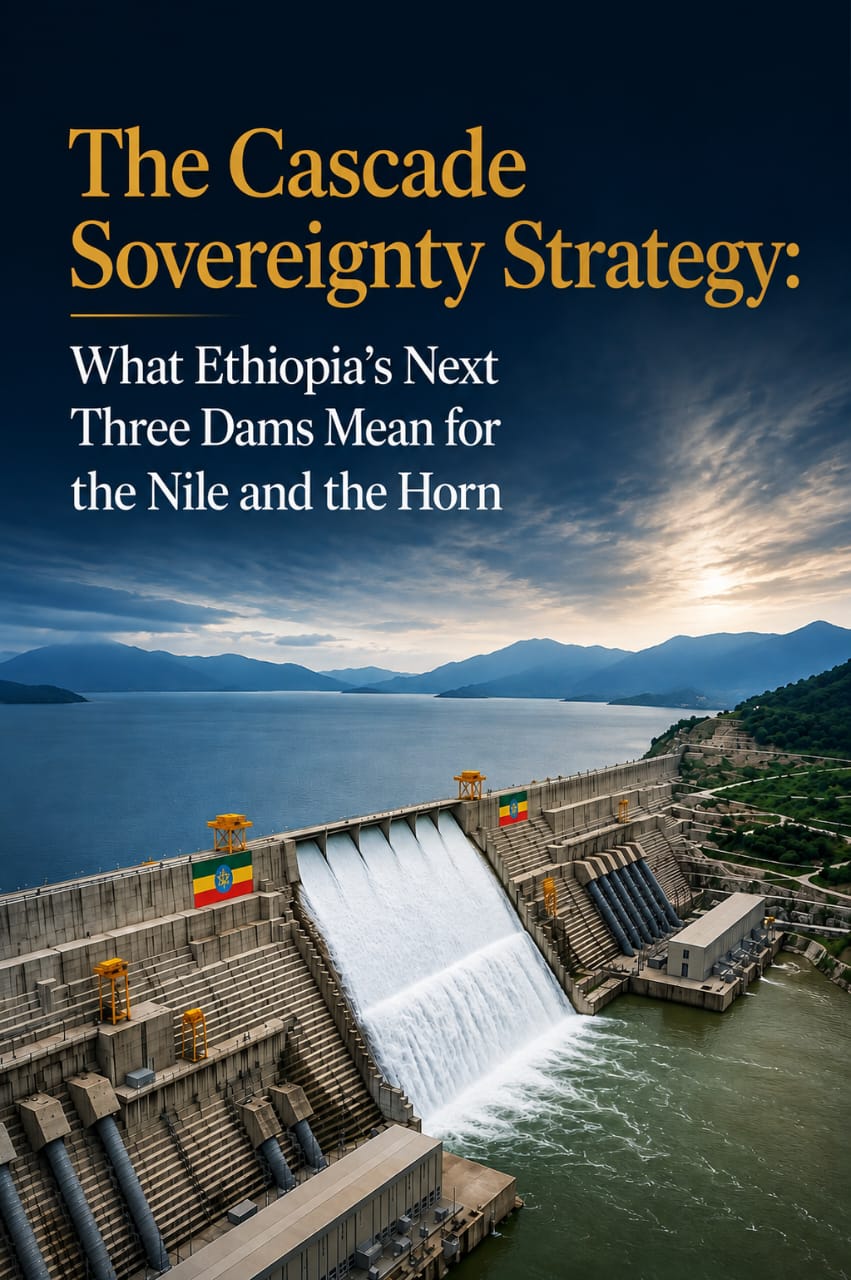
Less than a year after the Grand Ethiopian Renaissance Dam’s formal inauguration in September 2025, Ethiopia is advancing plans for a new phase of Blue Nile hydropower development. In March 2026, Ethiopia’s Ministry of Water and Energy announced plans for three projects—Karadobi, Mandaya and Beko Abo—under a wider Blue Nile cascade programme. Public reporting on the ministry’s announcement puts their combined planned generating capacity at approximately 5,700 megawatts and the investment requirement at about US$10.5 billion, with a target of completing the projects within seven years. Because the projects remain at the planning and procurement stage, their final designs, costs, schedules and capacities should not be treated as fixed.
The announcement matters for reasons that extend beyond the immediate Egypt–Ethiopia dispute. GERD was a landmark demonstration of Ethiopia’s ability to mobilise national resources around a single transformative infrastructure project. The proposed cascade raises a different strategic question: whether that capacity can be converted into a repeatable national energy-development model. If implemented, the three projects would deepen Ethiopia’s hydropower portfolio, expand the country’s electricity-generation base and potentially strengthen its role in regional power markets.
The development also creates a more complex diplomatic environment. Egypt remains deeply concerned about the cumulative implications of additional upstream infrastructure, particularly for drought management and the predictability of downstream flows. Sudan has its own interests, which include both potential benefits from regulated flows and electricity as well as concerns about dam safety, operational coordination and information sharing. Ethiopia’s strategic challenge is therefore not simply to defend its right to develop. It is to demonstrate that development, transparency and basin cooperation can reinforce one another.
Historical Context
The three proposed projects are not entirely new ideas. Earlier Nile Basin Initiative and Eastern Nile Technical Regional Office studies examined Karadobi, Mandaya and Beko Abo as potential hydropower sites and considered different configurations for a broader cascade. A 2007 pre-feasibility study, for example, examined Mandaya together with Karadobi and a possible Beko Abo development. More recent academic work also identifies all three among projects examined through NBI-sponsored studies.
What is new is not the existence of these sites in Ethiopia’s long-term hydropower planning, but the movement toward a more concrete implementation phase. This distinction is important. It suggests continuity in Ethiopia’s energy-development strategy rather than the sudden creation of an entirely new policy objective after GERD.
Ethiopia’s broader position rests on the principle that a sovereign upstream state has a legitimate interest in equitable and reasonable utilisation of a shared watercourse. Addis Ababa has not regarded the 1929 and 1959 Nile arrangements as binding settlements of Ethiopia’s rights, noting that Ethiopia was not a party to them. The 2015 Declaration of Principles, however, provided a trilateral framework that emphasised cooperation, equitable and reasonable utilisation, avoidance of significant harm and information exchange. The continuing absence of a comprehensive, binding operating arrangement means that every new major project is likely to be interpreted through the unresolved political history of the basin.
Strategic Logic of a Cascade
GERD demonstrated Ethiopia’s capacity to complete a project of continental significance. A cascade would demonstrate something different: institutional continuity. Multiple large projects require sustained engineering expertise, project-management capacity, financing, transmission investment and regulatory coordination. If Ethiopia can reproduce these capabilities across several projects, hydropower becomes not merely a flagship infrastructure achievement but a durable pillar of national economic strategy.
The proposed configuration also has distinct technical functions. Karadobi has been described as having an important basin-regulation and sediment-management role, while Mandaya and Beko Abo are planned primarily around large-scale power generation. The ministry’s reported combined capacity of about 5,700 MW would represent a substantial addition to Ethiopia’s generating portfolio.
Yet the strategic significance should not be reduced to megawatts. A cascade can affect reservoir operations, sediment transport, seasonal flows and the management of drought conditions. The stronger Ethiopian argument is therefore not that additional infrastructure has no possible downstream consequences. Rather, it is that those consequences can be assessed technically and managed through appropriate coordination while Ethiopia retains its development rights.
Current Dynamics: Egypt and Sudan
Egypt’s response is shaped by the country’s exceptional dependence on the Nile and by the experience of the GERD negotiations. From Cairo’s perspective, the issue is increasingly cumulative: the question is not only how GERD operates, but what a future network of upstream reservoirs could mean for water availability, drought-year management and Egypt’s ability to anticipate changes in the river’s flow regime.
That concern should be taken seriously without accepting the proposition that Ethiopia’s hydropower development is inherently incompatible with downstream interests. The distinction between consumptive water use and hydropower generation remains important. Hydropower projects can generate electricity without consuming the water in the same way as irrigation withdrawals. At the same time, reservoirs alter the timing and management of flows, meaning that operational coordination remains relevant even where the principal objective is electricity generation.
Sudan occupies a more nuanced position. Its proximity to Ethiopia gives it direct interests in Blue Nile regulation, sediment management, flood control and dam safety. At the same time, greater hydropower generation and more regulated flows can offer economic benefits. Sudan should therefore be approached as an independent riparian stakeholder whose interests cannot simply be assumed to coincide with either Addis Ababa or Cairo.
For Ethiopia, this creates an opportunity. Rather than treating every downstream concern as an attempt to constrain Ethiopian development, Addis Ababa can use the new phase of hydropower planning to promote a more technical approach to Nile governance. Advance information sharing, joint modelling, operational communication and technical committees can reduce uncertainty without requiring Ethiopia to relinquish its sovereign development objectives.
Power Structure and Strategic Autonomy
The cascade also has implications for the regional balance of power. Ethiopia already possesses one of Africa’s largest hydropower potentials and has expanded its electricity-generation capacity significantly in recent years. The Ethiopian Electric Power has reported that installed generation capacity increased from 4,462 MW to 9,752 MW over the seven years to 2026, while electricity access rose from 44 percent to about 54 percent.
The strategic objective is consequently broader than Nile politics. Ethiopia seeks to use renewable energy to support industrialisation, expand domestic electricity access and increase electricity exports. A larger generation base could strengthen interconnection with neighbouring markets and make Ethiopia a more significant participant in East African power trade.
This is where the cascade becomes a regional issue rather than simply a bilateral Egyptian Ethiopian dispute. If surplus electricity can be reliably transmitted to neighbouring states, Ethiopia’s hydropower assets become part of a regional economic network. Electricity trade can create interdependence that is structurally different from the politics of water allocation: states can purchase a service from Ethiopian generation without requiring Ethiopia to surrender its upstream development rights.
Regional Implications for the Horn
The Horn of Africa’s energy deficit remains one of the region’s structural constraints on industrialisation. Ethiopia’s expansion of renewable generation could therefore have consequences well beyond its borders. Electricity exports to Kenya, Djibouti, Sudan and potentially South Sudan could support industrial activity and reduce reliance on more expensive or carbon-intensive generation sources.
This regional dimension provides Ethiopia with a constructive diplomatic narrative. Instead of presenting the Blue Nile cascade solely as an expression of sovereignty, Addis Ababa can frame it as part of a wider regional energy transition. Such a framing aligns national development with regional connectivity and gives neighbouring states a material stake in the success of Ethiopia’s energy infrastructure.
However, this strategy depends on transmission infrastructure, commercial agreements, financial sustainability and political stability. Generation capacity alone does not automatically translate into regional influence. Ethiopia will need to ensure that electricity exports are reliable, commercially competitive and supported by credible institutions.
The Governance Test
The most important test of the cascade will therefore be governance. The strongest version of Ethiopia’s strategy is not simply ‘build more dams.’ It is ‘build, disclose, coordinate and trade.’ Building protects the country’s development ambitions. Disclosure reduces uncertainty about project design and environmental implications. Coordination addresses operational risks. Trade converts generation capacity into regional economic interdependence.
This approach would also strengthen Ethiopia’s diplomatic position.
A programme accompanied by credible environmental and hydrological assessments, transparent technical information and practical consultation mechanisms would be harder to characterise as an inherently coercive project. Conversely, insufficient information-sharing could allow uncertainty to become a political multiplier, even where projects are technically designed primarily for power generation. Ethiopia therefore has an opportunity to distinguish sovereignty from unilateralism. Sovereignty means retaining the ability to pursue legitimate national development. Effective basin diplomacy means exercising that ability in a way that reduces avoidable uncertainty for co-riparians.
Conclusion: From GERD to a Regional Energy Strategy
GERD demonstrated Ethiopia’s capacity to complete transformative infrastructure through sustained national mobilisation. The proposed cascade would test whether that capacity can become institutional, repeatable and regionally consequential. Karadobi, Mandaya and Beko Abo matter not simply because of their projected generating capacity, but because they could represent the next stage of Ethiopia’s energy strategy: moving from a single landmark project toward a portfolio of major renewable-energy assets designed to support domestic electrification, industrialisation and regional electricity trade.
For Addis Ababa, the strategic objective should be to preserve Ethiopia’s equitable and reasonable utilisation of its water resources while building confidence around the technical management of the basin. This does not require Ethiopia to abandon hydropower development, nor does it require downstream states to disregard their legitimate concerns. It requires institutions capable of separating technical questions from political escalation.
The future of the Nile will not be determined by dams alone. It will be shaped by the rules, data, institutions and political relationships governing them. Ethiopia now has an opportunity to make the next phase of its hydropower development a demonstration not only of national capability, but of how sovereignty, development and regional cooperation can coexist.
Notes
1. MadaMasr, “Ethiopia unveils 3 new hydropower projects on Nile, stoking concerns in Cairo,” 26 March 2026. The report attributes the project announcement, combined 5,700 MW capacity and approximately US$10.5 billion investment to Ethiopia’s Ministry of Water and Energy. See also Middle East Forum, “Ethiopia Dams the Nile for Power,” 7 May 2026.
2. Eastern Nile Technical Regional Office/Nile Basin Initiative, Eastern Nile Power Trade Program Study, Module M5: Pre-feasibility Studies of Hydropower Projects, Mandaya, 2007; and Oxford Academic, Dams, Power, and the Politics of Ethiopia’s Renaissance, table on proposed dams in NBI-ENTRO-sponsored pre-feasibility studies.
3. MadaMasr, 26 March 2026. The ministry presentation reported Karadobi at 1,600 MW, Mandaya at 2,000 MW and Beko Abo at 2,100 MW. These are planned capacities and may change as project design advances.
4. Ethiopian News Agency, “Ethiopia Doubles Power Generation in Seven Years, Moves to Africa’s Leading Energy Hub: EEP,” 2 May 2026.
5. For the historical and legal context of the Nile agreements and the 2015 Declaration of Principles, the article retains the distinction between Ethiopia’s stated legal position and the fact that Egypt and Sudan interpret the basin’s legal and operational framework differently.
Selected Sources
MadaMasr — Ethiopia unveils 3 new hydropower projects on Nile, 26 March 2026.
Nile Basin Initiative / ENTRO — Eastern Nile Power Trade Program Study, Module M5: Mandaya Pre-feasibility Study.
Oxford Academic — Dams, Power, and the Politics of Ethiopia’s Renaissance.
Ethiopian News Agency — Ethiopia Doubles Power Generation in Seven Years, 2 May 2026.
Springer Nature — Achievements, challenges and future pathways of hydropower development in Ethiopia, 3 June 2026.
By Hanan Hassen, IFA
Disclaimer:
The content disseminated by the Institute of Foreign Affairs (IFA) – including, but not limited to, publications, public statements, events, media appearances, and digital communications – reflects the views of individual contributors and does not necessarily represent the official positions or policies of the Institute, its partners, or any affiliated governmental or non-governmental entities.
While the IFA endeavors to ensure the accuracy, integrity, and timeliness of the information presented, it makes no representations or warranties, express or implied, regarding the completeness, reliability, or suitability of such content for any purpose. The Institute expressly disclaims any liability for errors or omissions, as well as for any actions taken or decisions made based on the information provided.
The inclusion of external links, references, or third-party resources does not constitute an endorsement by the Institute. Additionally, engagement on social media platforms – including, but not limited to, likes, shares, retweets (RTs), or reposts – shall not be interpreted as an endorsement or validation of the views expressed therein.
Readers and audiences are encouraged to exercise critical judgment and seek independent verification when interpreting or relying upon any information disseminated through publications and posts on the Institute’s platforms or representative.