
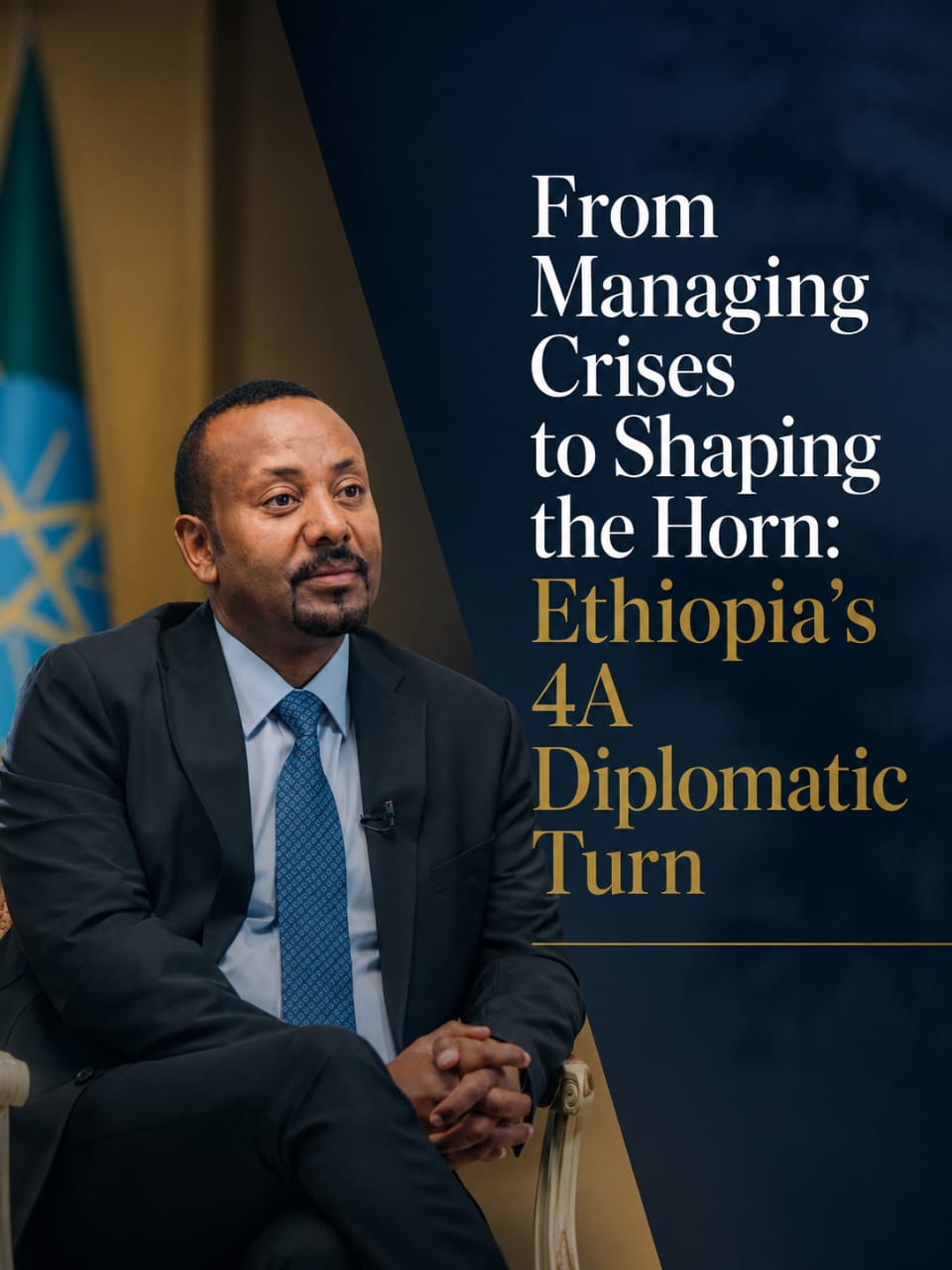
For much of the past decade, Ethiopian diplomacy has been defined by the management of constraints: containing security threats, repairing strained relationships and responding to developments largely shaped by other actors. What is increasingly visible, however, is a different diplomatic instinct. Addis Ababa is not simply responding to the regional order; it is attempting to acquire greater influence over the terms on which that order is negotiated.
This shift can be captured through four tendencies: Active, Alternative, Adaptive and Agenda-Setting. Taken together, they suggest an emerging diplomatic doctrine centred on strategic agency. The significance of the 4A posture is therefore not that Ethiopia has suddenly become more active abroad. Rather, it is that the method of Ethiopian diplomacy appears to be changing from managing constraints to manipulating the diplomatic space within which those constraints operate. The distinction is important. A state can be diplomatically busy without becoming strategically influential. The question is whether Ethiopia's growing diplomatic activity is producing greater room for manoeuvre.
Active: Creating Diplomatic Space
The first shift is from responding to initiatives set elsewhere toward generating initiatives of its own. Ethiopia's pursuit of Red Sea access illustrates this transformation. The 2024 Ethiopia Somaliland memorandum was controversial precisely because it demonstrated a willingness to place the maritime question at the centre of regional diplomacy rather than accept landlockedness as a fixed geopolitical condition. Whatever the subsequent recalibration, the episode changed the diplomatic conversation: Ethiopia's access to the sea became a question around which neighbouring states and external powers were required to position themselves.
This is the strategic value of active diplomacy. It does not necessarily mean securing the desired outcome immediately. It means creating a negotiating environment in which Ethiopia's interests cannot easily be excluded. Yet initiative can also produce resistance. The more Ethiopia attempts to expand its strategic room, the greater the incentive for other states to coordinate around limiting that expansion. Active diplomacy therefore creates opportunity and counter-pressure simultaneously.
Alternative: Escaping Diplomatic Gatekeepers
The second element is diversification not merely of partnerships, but of diplomatic mechanisms. The Ankara Declaration demonstrated the value of this approach. Turkish mediation provided Ethiopia and Somalia with a channel through which their dispute could be reframed without requiring either side to abandon its fundamental position. The resulting framework reaffirmed sovereignty and territorial integrity while leaving space for negotiations concerning Ethiopia's maritime interests.
The importance of Ankara lies partly in the mediator itself. Turkey represents a category of diplomatic actor that increasingly matters in the Horn: neither a traditional Western power nor a neighbouring state directly implicated in the dispute. For Ethiopia, cultivating such channels reduces the risk that any single actor becomes a diplomatic gatekeeper. Engagement with Turkey, Gulf states, the European Union and other partners consequently serves not only foreign-policy diversification but strategic autonomy.The challenge is ensuring that diversification produces leverage rather than diplomatic fragmentation. Multiple partnerships matter only when Addis Ababa can use them to reinforce a coherent strategic objective.
Adaptive: Flexibility Around Fixed Interests
If the first two elements concern initiative and choice, adaptation concerns timing. The regional environment around Ethiopia is changing too quickly for a rigid diplomatic alignment to remain effective. Sudan's war has altered calculations along Ethiopia's western frontier and the Red Sea. International naval operations have expanded the security architecture around the Bab el-Mandeb. Gulf states continue to combine commercial, political and security interests across the Horn.
In such an environment, Ethiopia's advantage may lie less in choosing a permanent camp than in maintaining sufficient relationships to avoid strategic dependence on any one of them. Adaptive diplomacy is not simply the accumulation of alternatives. Its value lies in preserving flexibility while keeping Ethiopia’s strategic objectives fixed. Partnerships, channels and diplomatic tactics may change as circumstances change, but the national interests they are intended to advance should remain clear. For Ethiopia, maritime access, economic connectivity and strategic autonomy increasingly provide that underlying objective. The diplomatic instruments used to pursue them can change as regional alignments change.
Agenda-Setting: Turning National Priorities into Regional Questions
The fourth A is the most ambitious. A state gains influence not only when its position is heard, but when its priorities become part of the questions that regional diplomacy must address.Ethiopia's maritime agenda increasingly demonstrates this distinction. The question is no longer simply whether Ethiopia should obtain access to a port. It is whether the region can develop arrangements that reconcile Ethiopian economic interests with coastal-state sovereignty and wider Red Sea security. That reframing matters because it moves the debate away from a zero-sum contest between Ethiopia and its neighbours. It creates the possibility of presenting Ethiopia's maritime requirement as part of a wider regional architecture of connectivity.
Agenda-setting is therefore the point at which the other three As are tested together. Initiative places Ethiopian priorities on the diplomatic table; alternative channels widen the routes through which they can be pursued; adaptation allows the method to change without losing the objective. The final challenge is whether Ethiopia can translate those advantages into regional outcomes. That depends not only on diplomatic creativity, but also on credibility, resources and political stability.
The Pretoria Test
The 4A posture ultimately faces its most important test at home. The Pretoria Cessation of Hostilities Agreement ended the Tigray war, but the political settlement that followed remains incomplete. Questions surrounding territorial administration, political authority, institutional normalization and the implementation of outstanding provisions continue to shape federal–Tigrayan relations. Divisions within the TPLF have further complicated the political process.
For Ethiopia, however, the significance of Pretoria extends beyond the peace process itself. It is a test of strategic bandwidth. A state seeking greater influence abroad must be able to sustain political attention, institutional coordination and resources at home. This does not mean Ethiopia must resolve every domestic disagreement before pursuing an active foreign policy. It means that unresolved internal tensions can narrow the room within which external strategy can operate.
This makes the continuation of political dialogue and the consolidation of the Pretoria framework strategically important. Keeping outstanding questions within political and institutional channels strengthens Ethiopia’s capacity to pursue longer-term regional objectives rather than repeatedly diverting attention toward renewed internal confrontation.The 4As therefore have a domestic foundation: initiative requires capacity, adaptation requires attention and agenda-setting requires credibility.
Conclusion: From Room to Manoeuvre to Strategic Weight
Ethiopia’s 4A posture represents an emerging effort to widen strategic choice. Active diplomacy places Ethiopian priorities on the table; Alternative diplomacy broadens the channels available to pursue them; Adaptation allows methods to change as regional alignments shift; and Agenda-Setting seeks to make Ethiopia’s core interests part of the region’s diplomatic calculations. But diplomatic activity alone does not constitute strategic power. The real test is whether Ethiopia can institutionalize its diplomatic gains while strengthening the domestic foundations that sustain them.This is why Pretoria matters to the broader 4A project. Consolidating the peace process is not separate from Ethiopia’s regional ambitions; it is part of creating the political bandwidth required to pursue them.
The deeper transition is therefore not simply from managing crises to shaping the Horn. It is from operating within a diplomatic environment largely set by others to increasing Ethiopia’s ability to influence the choices available within that environment. If Addis Ababa can sustain diplomatic initiative while consolidating domestic political stability, the 4As could evolve from a pattern of diplomatic behaviour into a durable strategy of regional statecraft.
Reference
International Crisis Group “Ethiopia, Eritrea and Tigray: A Powder Keg in the Horn of Africa” (18 February 2026)
International Crisis Group — Ethiopia, Eritrea and Tigray
Frontiers in Political Science “Ethiopia after the Pretoria Agreement: Red Sea Geopolitics and the Challenges of Fragile Peace” (2026)
Frontiers in Political Science — Ethiopia after the Pretoria Agreement
Institute for Security Studies (ISS Africa) Ethiopia Development Futures (2026) ISS Africa — Ethiopia Development Futures
ISS Africa Somalia Development Futures (2026)
ISS Africa — Somalia Development Futures
European External Action Service EU–Djibouti Status of Forces Agreement / Operation ASPIDES (16 July 2026)
EEAS — EU–Djibouti Status of Forces Agreement
By Amen Biniyam, IFA
Disclaimer:
The content disseminated by the Institute of Foreign Affairs (IFA) – including, but not limited to, publications, public statements, events, media appearances, and digital communications – reflects the views of individual contributors and does not necessarily represent the official positions or policies of the Institute, its partners, or any affiliated governmental or non-governmental entities.
While the IFA endeavors to ensure the accuracy, integrity, and timeliness of the information presented, it makes no representations or warranties, express or implied, regarding the completeness, reliability, or suitability of such content for any purpose. The Institute expressly disclaims any liability for errors or omissions, as well as for any actions taken or decisions made based on the information provided.
The inclusion of external links, references, or third-party resources does not constitute an endorsement by the Institute. Additionally, engagement on social media platforms – including, but not limited to, likes, shares, retweets (RTs), or reposts – shall not be interpreted as an endorsement or validation of the views expressed therein.
Readers and audiences are encouraged to exercise critical judgment and seek independent verification when interpreting or relying upon any information disseminated through publications and posts on the Institute’s platforms or representative.