
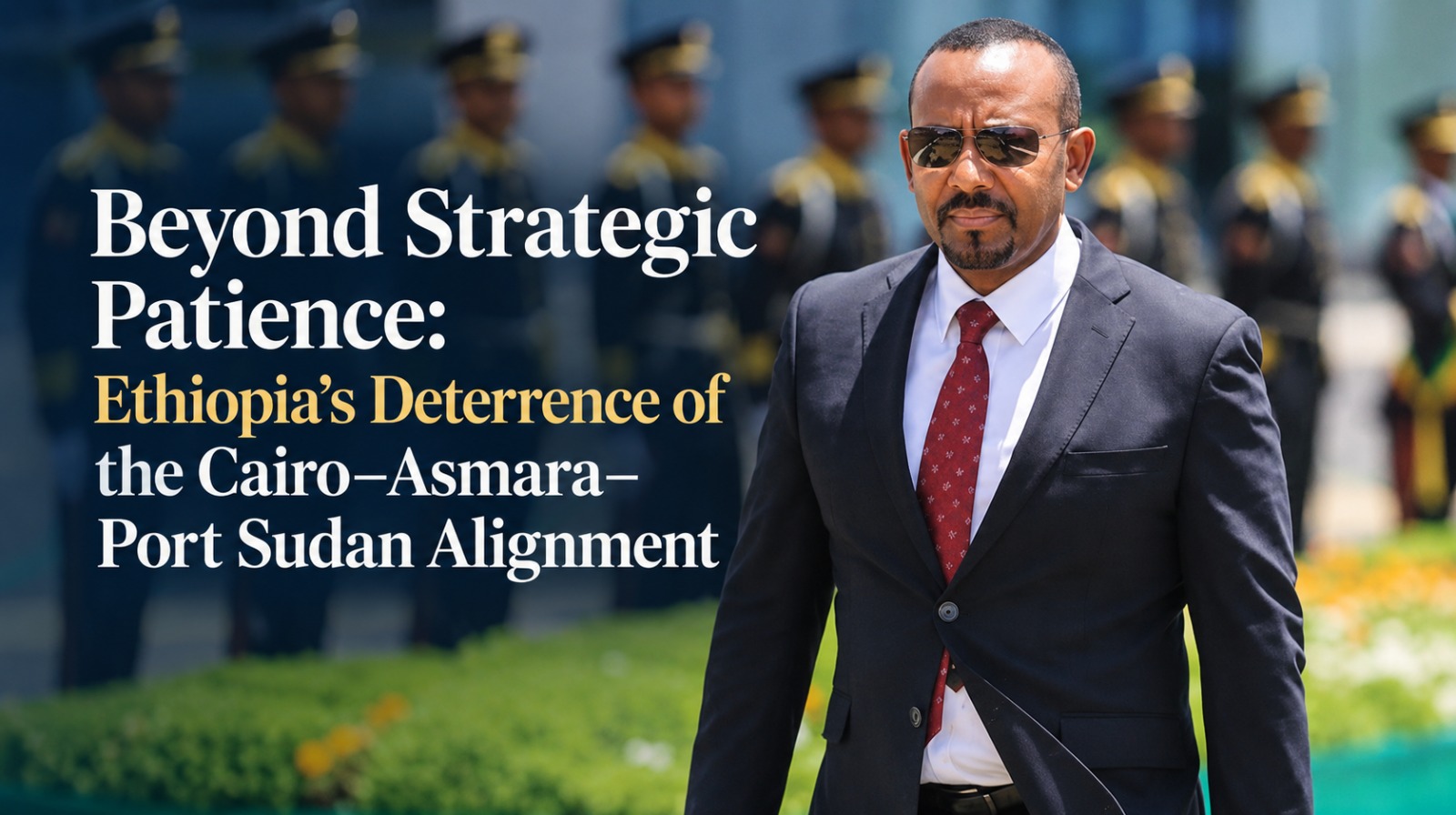
The capture of Mekelle by federal forces on 3 October 2026 has altered the immediate military balance in northern Ethiopia. TPLF-led forces withdrew from the regional capital after less than two weeks of renewed fighting. The conflict is not necessarily over, since TPLF forces and allied groups can still operate outside the main urban centres and the political disputes behind the renewed war remain unresolved. Yet the fall of Mekelle demonstrates once again the failure of the Isaias Afwerki doctrine: the attempt to expand Eritrea's buffer zone and strategic depth, and to constrain the federal government through proxy deterrence. Once the contest turns conventional, Addis Ababa holds the decisive advantage, because it commands an integrated defence system that joins air power, ground forces, intelligence, cyber and digital capabilities under a central command structure.
The development coincides with the Alamein consultative summit in Egypt, which brings together President Sisi, President Isaias Afwerki, Sudanese Armed Forces (SAF) commander Abdel Fattah al-Burhan and Somali President Hassan Sheikh Mohamud. Sisi describes it as consultations on regional issues of mutual interest, but its timing is hard to separate from the rupture between Addis Ababa and the Cairo backed axes.
The renewed fighting has revived a familiar either-war-or-status-quo framing of Ethiopia–Eritrea relations, in which the choice is another war or the preservation of an uneasy peace. Both positions reduce a complicated security relationship to prediction. The more important question is what produces the present tension and what could turn it into military confrontation. Much of the recent commentary attributes the danger principally to Ethiopia's direct sea-access policy. Ethiopia's aspiration to regain a physical presence on the Red Sea is undoubtedly an important source of tension with Eritrea and, by extension, with Egypt. But treating sea access as the direct or principal cause of a possible war is reductionism. It confuses an important issue in the dispute with the causes that structure the dispute itself.
The previous Ethiopia–Eritrea war is a good evidence. Ethiopia's maritime interest predates the 1998–2000 conflict. The country became landlocked following Eritrea's independence de facto in 1991 and de jure in 1993. The Red Sea and Gulf of Aden have consequently remained matters of long-term national security for Ethiopia. For a country whose economic, geography, regional influence and role as a Horn anchor state are closely connected to the Red Sea, reliable, sustainable and permanent maritime access has increasingly been understood in Addis Ababa as an existential necessity.
Yet landlockedness did not produce war. Addis Ababa and Asmara maintained close relations after independence, Ethiopian trade continued through Assab and Massawa, and the TPLF and EPLF leaderships remained closely connected. War came in 1998 through several disputes. The border was the proximate cause, but trade, currency, citizenship and economic relations had already produced serious friction between the two ruling movements.
Sea access therefore cannot carry the explanatory weight that much commentary places on it. It aggravates the dispute without being its source. The confrontation is better explained by structural causes: the unsettled consequences of Eritrea's separation from Ethiopia, incompatible conceptions of regional order in Addis Ababa and Asmara, the continuation of the Isaias doctrine of containing Ethiopia, and the wider competition over the Nile, Red Sea and Horn of Africa. The deeper problem is not access to a sea. It is that Eritrea, a territory historically part of the Ethiopian political and civilizational space and detached from it by colonial partition and then by secession, has never settled its relationship with the state it left.
Unsettled Separation and Ontological Insecurity
Eritrea's independence drew a juridical and cartographic line, but it did not complete an ontological separation. A border can divide territory, yet it cannot by decree divide peoples, histories, languages, religious communities, kinship networks and the shared inheritance of a long political existence. The physical separation is therefore much clearer than the metaphysical separation. Pan-Ethiopian nationalists have found it difficult to treat Eritrea as an entirely external strategic space. Eritrean nationalism, for its part, had to construct a self that could stand apart from that inheritance, and it did so by making Ethiopia the principal Other against which the Eritrean self is defined. The relationship has consequently never acquired the character of a normal post-separation interstate relationship.
This produces an ontological security problem. Ontological security concerns a state's need to sustain a stable narrative of who it is, and it can be threatened even when no physical threat exists. A state whose identity rests on a founding act of separation needs the Other from which it separated, because that Other keeps the founding narrative alive. The persistence of Ethiopia as Eritrea's constitutive Other therefore does political work well beyond conventional security: it legitimizes a militarized order, justifies indefinite mobilization and postpones the questions that a normal polity must answer about itself.
The contradiction is that an identity built on opposition to Ethiopia becomes harder to sustain if relations normalize and interdependence replaces confrontation. Peace is therefore a threat to the Eritrean self in a way that hostility is not. The problem also runs in the opposite direction. Ethiopia's historical, social and economic ties with Eritrea have prevented full psychological acceptance of the post-1993 order among many Ethiopians. This does not mean Ethiopia seeks to reverse Eritrean independence. It means that separation did not erase the historical relationship between the two societies or Ethiopia's enduring interest in the Red Sea.
The security consequences became visible after 1998–2000, when each state increasingly sought security through the internal weakness of the other. Eritrea's conduct reflects containment through proxy engagement. It supported Ethiopian opposition movements and cultivated relationships with armed actors inside Ethiopia. This is the core of what can be termed the Isaias doctrine: rather than confronting Ethiopia directly, Asmara creates buffer zones through proxy engagement, maintains pressure on Addis Ababa and builds regional axes capable of constraining Ethiopia from several directions. Its premise is: ‘a strong and consolidated Ethiopia reduces Eritrea's room for manoeuvre, while a divided Ethiopia with forces dispersed across several fronts gives Asmara strategic depth.’
The Meles administration pursued a different conception of regional order, consolidating Ethiopia as a regional anchor through peacekeeping, mediation, economic integration and diplomacy while limiting Eritrea's capacity to shape the region. Eritrea's isolation and Ethiopia's prominence reinforced one another. The resulting equilibrium was stable only in appearance. It held for as long as Asmara tolerated exclusion from the Horn's institutional architecture, and it left Eritrea with every incentive to disrupt an order in which it had no place.
2018 and the Attempt to Reorder the Horn
The 2018 rapprochement departed from this pattern. Under Prime Minister Abiy Ahmed, Ethiopia did not seek to preserve Eritrea's isolation but to reintegrate it into the regional system, replacing confrontation with cooperation and interdependence. Ethiopia supported normalization, advocated Eritrea's return to the regional institutions and contributed to the diplomatic environment that preceded the UN Security Council's lifting of sanctions on Eritrea in November 2018. Resolution 2444 welcomed the July 2018 Joint Declaration of Peace and Friendship and the subsequent Ethiopia–Eritrea–Somalia cooperation agreement. The policy reflected a different conception of the Horn: an integrated cooperative regional order in which Ethiopia served as economic, political and diplomatic anchor while its neighbors participated as active members. It was also an attempt to transform the security relationship, bringing Asmara into the regional order instead of containing it.
The years since have shown the limits of this approach. Reintegration lowered the political barriers between the two states but did not remove the underlying security dilemma, and the war in Northern Ethiopia (Tigray region) exposed the unresolved problem. Eritrea's military intervention showed that the old security relationship had not disappeared. Eritrea was not a party to the Pretoria agreement of November 2022, and Asmara read it as a mechanism that preserved a TPLF it wants dismantled. From that point relations between Addis Ababa and Asmara began to deteriorate, alongside renewed political fragmentation within Tigray and the proliferation of armed groups elsewhere in Ethiopia. The northern frontier once again became central to the regional balance.
The Northern Frontier and the Failure of the Isaias Doctrine
The renewed fighting is therefore more than another confrontation between the federal government and the TPLF. It tests whether the northern frontier can provide strategic depth for forces seeking to constrain Addis Ababa. The TPLF-led alliance that emerged in 2026 brought together organizations with different constituencies and objectives. Behind it, Eritrea, Egypt and the SAF leadership in Port Sudan are backing forces hostile to Addis Ababa, and several of those forces now operate in direct proximity to Ethiopia's borders.
The Isaias doctrine is being tested in exactly this setting. The buffer-zone strategy sought to keep conflict away from Eritrean territory. Instead of a direct conventional war, pressure would be exerted through pro-Asmara forces and proxy formations in Tigray, Afar, Amhara, Benishangul, Oromia and other peripheral areas: from the north through Tigray, from Afar along the northeastern corridor, from Amhara through the central-northern highlands, from western Ethiopia through the Sudan frontier, and from armed movements farther south. The objective was not necessarily the military defeat of the Ethiopian state. It was to stretch federal capacity, prevent Addis Ababa from concentrating its forces, disrupt critical corridors and infrastructure, and raise the domestic costs of governing Ethiopia.
The renewed war has exposed the weakness of the Isaias doctrine. The federal government did not remain outside Tigray while facing a proxy conflict. Federal and allied forces entered the region, used drones, air power and conventional ground forces, and regained key territory. The fall of Mekelle matters beyond control of the regional capital because it indicates that the northern buffer has failed to produce its intended military effect, at least in conventional terms. A politically coherent and militarily capable pro-Asmara force in Tigray could provide depth along Eritrea's southern frontier and constrain Addis Ababa, and the same logic applies to armed groups in Amhara and Afar. The federal advance has reduced their capacity to perform that function. The federal response has been to reverse the logic of dispersal by establishing state control over urban centres, major corridors and frontier areas while using the national defence force for conventional operations.
None of this means the problem is solved. The TPLF/TDF has suffered a serious conventional setback and its ability to reproduce the 2020 model of territorial warfare has been reduced. If the conflict continues, it is more likely to become rural insurgency, fragmented armed activity and contested local authority than a campaign capable of taking and holding major cities. A conventional defeat does not automatically produce political settlement. Ethiopia's recent experience shows how armed organizations fragment after battlefield losses and reproduce conflict at a lower level, producing a hybrid political order in which the federal state controls major cities and strategic corridors while armed groups retain influence in rural and peripheral areas. Even so, the strategic calculation has changed.
Cairo–Asmara–Port Sudan: Three Regimes, One Converging Concern
The wider question is what happens beyond Tigray. The answer lies partly in the convergence among the Sisi administration in Cairo, the Isaias Afwerki regime in Asmara and the SAF leadership based in Port Sudan. These are not identical actors and should not be treated as an alliance with a unified command structure. Their interests differ substantially, but they converge around a common concern: the emergence of Ethiopia as an increasingly consequential anchor state across the Nile, Red Sea and Horn of Africa geopolitical spaces.
Cairo is the principal external actor in this history. Egyptian strategy has long linked the Nile to the Red Sea: a state that controls the upper Nile and also commands the coast would escape the constraints on which the older Nile order depended. Cairo's backing of Eritrean secessionism was therefore never only a matter of sympathy for a nationalist cause. It served to push Ethiopia away from the sea and to leave it landlocked. Teferi's work documents how Egypt and Sudan became involved in the Eritrean question through their concern with Ethiopia's Nile development, and records the material support they gave to Eritrean secessionists.
The same concern persists today. The GERD has shifted the distribution of power in the Nile Basin and given Addis Ababa greater leverage than it had under the older order, and an Ethiopia with reliable maritime access would have greater economic and geopolitical autonomy still. Cairo therefore has an interest in preventing the simultaneous consolidation of Ethiopian influence over both the Nile and the Red Sea. Eritrean nationalism had its own roots, but it was Cairo that gave it strategic weight against Ethiopia.
For the Isaias Afwerki regime, Ethiopia's emergence as an anchor state would narrow Eritrea's room for manoeuvre. Assab is only one component of the dispute. The larger issue is whether Eritrea can retain influence over the regional order while Ethiopia expands its economic, diplomatic and geopolitical weight.
For the SAF leadership in Port Sudan, the calculation differs. Its primary concern is survival in Sudan's war and preservation of its territorial and political authority. But Ethiopia's western frontier is already part of that theatre. Port Sudan has sheltered armed formations affiliated with the TPLF, including units known as Army 70 and Army 13, has held territory that Ethiopia regards as its own, and has served as a venue where forces aligned against the Ethiopian government meet. Eastern Sudan thus offers proximity and opportunities for political, military and logistical interaction involving actors on both sides of the border.
The three interests converge without becoming identical. Cairo seeks to constrain Ethiopia's rise across the Nile and Red Sea, Asmara to prevent Ethiopia from becoming the dominant regional power, and the SAF leadership to preserve its position and limit Ethiopian influence over Sudan's eastern theatre. Together they produce pressure on Addis Ababa from three interconnected geopolitical spaces.
The Failure of Encirclement, Multi-Front War and Proxy Strategy
The alignment's strategy has been to encircle Ethiopia and fight it on several fronts through proxies: the Nile dispute in the north, Eritrea and Tigray in the northeast, eastern Sudan in the west, and armed organisations inside Ethiopia capable of forcing Addis Ababa to divide its attention. In its northern component this strategy has failed. The TPLF/TDF has been unable to achieve a decisive military outcome against federal forces, and the broader coalition has exposed significant internal contradictions. The capture of Mekelle removes its most important urban centre and gives the federal government greater freedom to strengthen state presence along the northern frontier.
This does not eliminate regional pressure. The alignment retains diplomatic and geopolitical value: Egypt has substantial weight in the Arab, Muslim and Western diplomatic circles, Eritrea holds a strategically located Red Sea coastline, and the SAF leadership controls important parts of Sudan's eastern political and military environment. The question is whether these advantages can be converted into effective coercion against Ethiopia, and there are reasons to doubt it. The international community has little interest in another Ethiopia–Eritrea war, the African Union has repeatedly called for restraint and dialogue, and international actors have invested considerable political capital in preventing the Tigray conflict from becoming a regional war.
The alignment also faces a collective-action problem. The three regimes share an interest in constraining Ethiopia but not necessarily a preferred end state, nor would they absorb the same costs from a wider war. Egypt does not border Ethiopia, Eritrea would carry the immediate military burden of an Ethiopia–Eritrea war, Sudan is consumed by its own war, and Somalia has its own vulnerabilities. A direct war would create risks for all of them.
Deterrence matters in this context. Its purpose is not to eliminate an opponent's political objectives but to convince an adversary that the expected cost of pursuing them through coercion will exceed the expected benefit. The federal government's demonstration of conventional superiority in Tigray therefore matters beyond the battlefield, because it raises the cost of using northern Ethiopian armed groups as instruments of regional coercion. The same applies to strengthening federal military and state presence along the frontier.
Beyond Strategic Patience
The post-2018 approach rested on accommodation, reintegration and regional interdependence. It assumed that bringing Eritrea back into the regional system would reduce the security dilemma created by years of isolation and proxy competition. That assumption proved incomplete, and the current environment requires a different balance between accommodation and deterrence. The federal government is strengthening its control of the northern frontier and reducing the possibility that Tigray can again serve as a conventional base for forces seeking to constrain Addis Ababa.
But military success alone will not settle the problem. If Tigray remains politically fragmented, if the questions of Western Tigray [Welkayit] and Raya remain unresolved, and if armed groups keep reproducing themselves after each round of fighting, Ethiopia could face the same security problem in a different form. The government therefore faces two connected tasks: denying the northern frontier to external coercion while building a political order in Tigray that reduces the incentives for armed mobilization. Security and political reintegration cannot be treated as separate projects.
The same principle applies to Eritrea. A credible Ethiopian deterrent should make direct intervention and proxy warfare less attractive to Asmara without creating the impression that Addis Ababa is preparing an offensive. Ethiopia's maritime interest should remain distinguishable from military confrontation, since access to the Red Sea and Gulf of Aden is a legitimate national interest and legal rights whose pursuit does not require war. The immediate danger is not that war is inevitable but that regional competition could make escalation easier and de-escalation harder.
The Cairo–Asmara–Port Sudan alignment remains relevant. It can continue to operate through diplomacy, intelligence cooperation, political support and proxy relationships even without direct military confrontation. Ethiopia's challenge is therefore not simply to defeat one armed coalition but to prevent the reproduction of the regional conditions that make such coalitions useful. For several years Addis Ababa relied heavily on strategic patience, accommodation and reintegration. The present environment calls for a recalibration: not a shift from diplomacy to war, but from patience without sufficient deterrent capacity to engagement backed by deterrence. Ethiopia does not need another regional war to protect its interests. It needs sufficient military, political and diplomatic capacity to make coercion against it less attractive while preserving space for negotiated solutions.
The objective, then, is not to build a counter-axis aimed at destroying the Cairo–Asmara–Port Sudan alignment. It is to ensure that the alignment cannot convert geographical proximity, proxy relationships and diplomatic coordination into an effective strategy for constraining Ethiopia's emergence as an anchor state in the Horn. Moving beyond strategic patience does not mean abandoning diplomacy. It means conducting diplomacy from a position in which coercion against Ethiopia is too costly to attempt.
Al Jazeera (2026, October 4). Ethiopian government forces seize Tigray capital Mekelle as TPLF withdraws. Al Jazeera. https://www.aljazeera.com/news/2026/10/4/government-forces-seize-capital-of-ethiopias-tigray-region-from-rebels
Dincel, S. (2026, October 3). Egypt to host 4-way summit with Eritrea, Somalia, Sudan amid Ethiopia conflict. Anadolu Ajansı. https://mobile.aa.com.tr/en/middle-east/egypt-to-host-4-way-summit-with-eritrea-somalia-sudan-amid-ethiopia-conflict/4077086?utm_source=chatgpt.com
Ford, D. M. (2026, October 1). Reignited violence in Ethiopia threatens to engulf the entire region. Responsible Statecraft. Available at: https://responsiblestatecraft.org/ethiopian-civil-war-tigray/
United Nations Security Council. (2018, November 14). Resolution 2444 (2018). United Nations. Available at:
https://www.securitycouncilreport.org/atf/cf/%7B65BFCF9B-6D27-4E9C-8CD3-CF6E4FF96FF9%7D/s_res_2444.pdf
United Nations. (2018, November 14). Eritrea sanctions lifted amid growing rapprochement with Ethiopia: Security Council. UN News.
African Union (2022, November 2). Cessation of hostilities agreement between the Government of the Federal Democratic Republic of Ethiopia and the Tigray People’s Liberation Front (TPLF). Available at: https://www.peaceau.org/en/article/cessation-of-hostilities-agreement-between-the-government-of-the-federal-democratic-republic-of-ethiopia-and-the-tigray-peoples-liberation-front-tplf
Reuters. (2026, October 2). Why renewed fighting in Ethiopia's Tigray risks a regional war. Reuters. Available at: https://www.reuters.com/world/africa/why-renewed-fighting-ethiopias-tigray-risks-regional-war-2026-10-02/
Tefri Mekonnen (2023). The Nile and Eritrea: The Nexus between Two Major Conflict Issues of Northeast Africa, 1941–1991. Ethiopian Journal of Social Sciences, 8(1), 84–117. Retrieved from https://www.ajol.info/index.php/ejss/article/view/241089
By Gashaw Ayferam Endaylau (P.h.D), Senior Horn Geopolitics and Hydro-politics the Researcher, Institute of Foreign Affairs. His research interest includes peace and security in the horn of Africa, Red Sea geopolitics, Nile politics, and emerging technologies. He can be reached via mugashawbzu@gmail.com gashaw.a.endaylalu@ifa.gov.et
Disclaimer
The content disseminated by the Institute of Foreign Affairs (IFA) – including, but not limited to, publications, public statements, events, media appearances, and digital communications – reflects the views of individual contributors and does not necessarily represent the official positions or policies of the Institute, its partners, or any affiliated governmental or non-governmental entities.
While the IFA endeavours to ensure the accuracy, integrity, and timeliness of the information presented, it makes no representations or warranties, express or implied, regarding the completeness, reliability, or suitability of such content for any purpose. The Institute expressly disclaims any liability for errors or omissions, as well as for any actions taken or decisions made based on the information provided.
The inclusion of external links, references, or third-party resources does not constitute an endorsement by the Institute. Additionally, engagement on social media platforms – including, but not limited to, likes, shares, retweets (RTs), or reposts – shall not be interpreted as an endorsement or validation of the views expressed therein.
Readers and audiences are encouraged to exercise critical judgement and seek independent verification when interpreting or relying upon any information disseminated through publications and posts on the Institute’s platforms or representatives.